Farewell to Botley
Thoughts on leaving a mean and sprawling suburb

Oxford is a watery city, ‘river-rounded’, an inland Venice. This gives it an odd shape. Look at a map of the place and you’ll see a small medieval nub, around which tendrils grow north, south, and west. The thickest of these is the former, comprising the dignified Victorian suburbs of Jericho, Park Town, and Summertown, which decline in glamour as they approach the northern ring-road. East Oxford is a patchy conurbation in its own right, as large as the centre and other suburbs put together.
Most of the green patches on the map easily explain themselves as the city avoiding floodplains around the Thames and its tributaries. Port Meadow is an especially well-preserved specimen of how most of the river would have looked before it was embanked, canalised, and otherwise hemmed in. The water expands into a shallow lake in winter, and contracts to its usual bounds in the summer months.
The proximity of the meadow is one of the many aspects of life in West Oxford I miss, having left six months ago. Our house there backed onto a brackish stream and the back of what was once an art deco ice rink, but is now an upscale supermarket to which I became severely addicted.
Botley, and West Oxford in general, have not always been fondly recalled. In his 1572 screed against immorality in the theatre, Stephen Gosson clarifies one of his points by saying: ‘I speak not this to preferre Botley, before Oxeford; a cottage of clownes, before a Colledge of Muses; Pans pipe, before Apollos harp.’ This hilltop village on the road west out of Oxford is a byword for rustic ignorance.
It was not always so. In the Middle Ages, the western outskirts of Oxford were rich in monasteries and abbeys. One was Wytham Abbey, which has survived, albeit with extensive remodelling, and was recently sold as a private house after a failed plan to make it an effective altruism retreat centre. Another was Godstow Abbey, the destruction of which the conservative protestant Samuel Daniel crowed over in his 1592 poem The Complaint of Rosamund. Its chapel and walls survive as ruins. The most impressive of these was Osney Abbey, site of the Synod of Oxford in 1222. My wife Herin tells me the supplementary canons to this synod were important for shaping the law of defamation, but it is best remembered for its unfortunate role in introducing restrictions on Britain’s Jewish population.
Botley’s most prominent place in the literary record is in C.S. Lewis’s wonderful memoir, Surprised by Joy, where it occupies an allegorical position almost as unflattering as in Gosson. The passage when Lewis first arrives in Oxford as an undergraduate is worth quoting at length:
My first taste of Oxford was comical enough. I had made no arrangements about quarters and, having no more luggage than I could carry in my hand, I sallied out of the railway station on foot to find either a lodging-house or a cheap hotel; all agog for ‘dreaming spires’ and ‘last enchantments’. My first disappointment at what I saw could be dealt with. Towns always show their worst face to the railway. But as I walked on and on I became more bewildered. Could this succession of mean shops really be Oxford? But I still went on, always expecting the next turn to reveal the beauties, and reflecting that it was a much larger town than I had been led to suppose. Only when it became obvious that there was very little town left ahead of me, that I was, in fact, getting to open country, did I turn round and look. There, behind me, far away, never more beautiful since, was the fabled cluster of spires and towers. I had come out of the station on the wrong side and been all this time walking into what was even then the mean and sprawling suburb of Botley. I did not see to what extent this little adventure was an allegory of my whole life.
Lewis must have known that Matthew Arnold’s view of the ‘dreaming spires’ was precisely from a hill in Cumnor, now firmly ensconced in Botley’s mean and sprawling suburbs. It was Arnold too who wrote that Oxford can be heard ‘whispering from her towers the last enchantments of the Middle Age… calling us near to that true goal of all of us, to the ideal, to perfection,—to beauty, in a word, which is only truth seen from another side’.1
Lewis does not expand on the idea that his accidental excursion into Botley was an allegory for his entire life. He presumably refers to the story his book describes, how he strayed from his childhood faith as a young man, only to return to it in a moment of realisation. Surprised by Joy concludes with what might be a nod to the Botley ‘allegory’, as Lewis describes the ‘joy’ he experienced throughout his life as a series of signposts, which had always been pointing in the right direction.
Botley’s place in this allegory is complicated. On the one hand, it represents the furthest point of Lewis’s straying from Arnold’s ideal of perfection, beauty and truth. On the other hand, it is the raised vantage point from which Lewis was able to recognise the truth, in a city which was ‘never more beautiful’ than at the moment he realised how far it was in the distance. Of course, it is both at once: the distance travelled along the paths of ignorance are redeemed in a moment once the true destination is recognised. To turn and recognise the mistaken path one has walked, as the publican does in Luke’s gospel (18:13), is the closest one can come to recognising the truth itself. To believe oneself in the perfect city already would be delusion, the city of God being, as Augustine writes, ‘on pilgrimage’ in this world, always a prospect at the end of a road.
Botley has charms of its own aside from its uses as theological allegory. The suburbs which Lewis called mean include many handsome mid to late Victorian terraces, the nicest of which are probably those built for railway workers on Osney island, made an island by the Thames and its tributaries. Here houses tended to be built in pairs, so that the same street can encompass many subtle differences of style or brickwork.
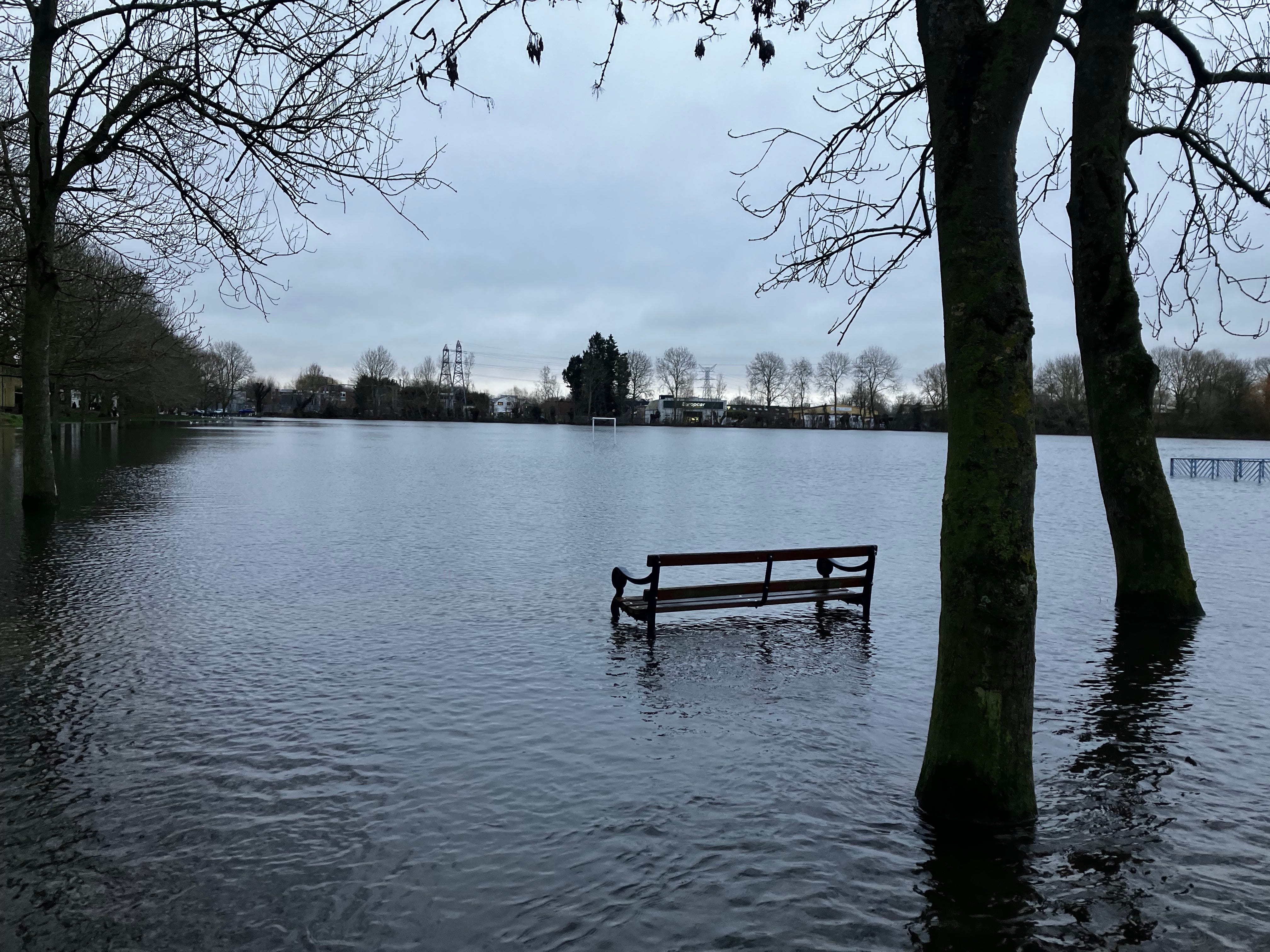
West Oxford’s odd shape means you are never far from a park, including two of the most beautiful urban nature reserves in the country: Port Meadow and Witham Woods. Flooding could be frightening and inconvenient, but produced some lovely temporary lakes. Local businesses are numerous and often quirky, such as a bike shop (Warlands) specialising in tandems and cargo bikes, an excellent café (Tumbling Bay), a piano shop, and a shop selling only Tuscan pots, open ‘by chance or by appointment’.
In truth, I never saw it open, and have seen many of these businesses (including the piano shop) relocate or close. For almost the entire time I lived there, the eponymous Botley Road has been closed thanks to a chronically mismanaged closure to facilitate the redevelopment of the station. The years-long delay, the result of a tangled mass of underground pipework and Victorian bridge foundations, and an equally tangled mass of Quangos and government bodies who have all blamed each other. The effects on businesses have clearly been serious, so, as a non-driver, I tended to keep quiet about how the closure had made the road pleasantly quiet.
Most of all, west Oxford is lovely for the reason that Lewis grudgingly acknowledged: the occasional glimpses of the city-centre it yields; the sense of being close but appreciably distant from one of the most striking cities in northern Europe.
The new Oxford station is set to include a west-facing entrance, making it far easier to get from the platforms to the city’s western suburbs. This could mean that more visitors will make C.S. Lewis’s mistake, which Gosson would have scorned, of visiting ‘Botley, before Oxeford’, seeing the city’s dreaming towers without the buses and tourists underneath them, and truth and beauty as a distant ideal rather than something to be grasped in an instant. That would be real progress.
lovely (sub)urbanism paul
Where are you going?