Reading Luke

Richmond Lattimore, the Greek scholar whose translation of the gospels I have been reading for the first time, said that his doubts about Christian faith disappeared ‘somewhere in Saint Luke’. The timing was not a coincidence: Lattimore seems to have especially admired Luke for his elegant Greek prose. We have Luke to thank for some of the Church’s finest devotional poetry. The ‘Hail Mary’, ‘Nunc dimittis’, ‘Benedictus’ and ‘Magnificat’ are all found in his first two chapters.
Luke has the clearest identity of all the evangelists, often being identified with ‘Luke, the beloved physician’, mentioned in Paul’s letter to the Colossians. His gospel is refined and carefully told, beginning with a preface setting out his aims as a writer, and forming a continuous narrative with Acts, Luke’s other contribution to the New Testament. His is the last of the ‘synoptic’ gospels, the term meaning ‘seeing together’, referring to the commonalities between Mark, Matthew and Luke, in contrast to John. Luke’s sources seem to have been Mark’s Gospel (though quite possibly a copy missing two chapters of material between Mark 6 and 8), a collection of Jesus’s sayings shared with Matthew (known to scholars as ‘Q’), and another collection of sayings unique to him (known as ‘L’). Luke was a scrupulous historian. He gives the most detailed account of Jesus’s birth, and seems even to have had a source inside Herod’s household.
John Donne described Luke as ‘more curious and more particular than the rest’, both because he was more learned and because he was a companion of Paul. Both of Donne’s adjectives cut two ways. ‘Curious’ of course denotes a desire for knowledge, as well as suggesting that something is a source of interest in its own right (as in, ‘the curious case of…’). In Donne’s time the word was often pejorative, suggesting over-inquisitiveness. ‘Be not too curious’ is a refrain that features in his sermons. ‘Particular’ could refer to Luke’s uniqueness among the other evangelists, as his gospel contains the highest proportion of unique material in the synoptic gospels: over a third of his account is not found in Matthew or Mark. ‘Particular’ could refer also to Luke’s ability to pick up on the particular, on the vital, telling detail. But perhaps there is a hint here at Donne’s dissatisfaction with the evangelist’s idiosyncrasy; being called ‘particular’ is not usually a compliment.
There is a similar ambivalence when Donne continues to describe the evangelist among the other synoptic gospels: ‘he writ last of three, and largeliest for himself’. To write largely for oneself can sound like indulgence, but in this context I think Donne means that Luke’s gospel has an investment in personal piety. The sermon in which Donne’s remarks on Luke occurs is in part an explanation of why Christ says ‘Father forgive them, for they know not what they do,’ only in Luke’s gospel. In saying that Luke wrote ‘largeliest for himself’, Donne means that the evangelist took some share in the ignorance and need for forgiveness expressed in this verse. To write a gospel full of stark moral challenge for oneself is really the opposite of self-indulgence.
Certainly, if Luke was a doctor, he wrote little out of professional self-interest. Only in Luke does Jesus paraphrase the crowds in Nazareth as saying ‘Physician, heal thyself’, using a proverb which presumably refers to physicians’ inability to heal anyone else. Only Luke includes the detail that the woman with a years-long haemorrhage had spent all her money on doctors who ultimately proved useless (a detail oddly missing from Lattimore’s version). Much like Mark’s possible self-portrait in the man running naked from Gethsemane, Luke’s representation of the physicians among whose number he may have counted himself is notably unflattering.
Donne’s comment that Luke wrote ‘largeliest for himself’ is odd in respect of the fact that Luke’s is the only gospel addressed to a specific person, the ‘most exalted Theophilus’, though of course it is addressed to all who share the ‘love of God’ implied by the name. The gospel itself takes an interest in this equivocation, evident in a moment in Chapter 12 when Peter asks Jesus if the parables he has told about staying awake for the return of the master are addressed to all, or only to the disciples. Jesus replies with another parable, as if even to ask the question is to miss the point. The new parable does imply the answer, by describing as blessed that servant who serves the master even in the master’s absence: this parable is for all who live faithfully, and do the Lord’s will.
In Luke’s gospel God’s blessing is reserved especially for ‘the poor’. It is not for nothing that Luke has sometimes been termed ‘the gospel of the poor’, though really it should be ‘the gospel to the poor’, as this is how Christ describes his ministry towards the gospel’s opening. ‘Blessed are the poor’ is how Jesus begins his sermon on the plain, Luke’s stark answer to Matthew’s sermon on the mount, leaving out Matthew’s qualifying ‘in spirit’ which left more room for the redemption of those whose poverty is not fully reflected a lack of material possessions.
Luke’s conception of ‘the poor’ is, however, both more capacious and more limited than might first appear. The poor are certainly not the general mass of the populace, as Luke is of all the evangelists the most sceptical of crowds’ capacity for acting out of good will. Immediately after Jesus has declared his intention, by reading a section of Isaiah and applying it to himself, ‘to preach the gospel to the poor’ at a synagogue in Nazareth, his compatriots are not only enraged, as in Matthew and Mark, but go as far as trying to throw him off a cliff. Luke specifies that it was only the disciples, not the general mass of people, who celebrated Jesus’s entry into Jerusalem. Pontius Pilate seems keenest in Luke to spare Jesus from execution, and condemns him only at the crowd’s spontaneous insistence.
If the ‘the poor’ are not the common people, they do nonetheless include wealthy tax-collectors such as Zacchaeus, who is redeemed for giving up a sizeable proportion (though not all) of his possessions. Luke does emphasise Jesus’s concern for the marginalised, being the only gospel to include the parable of the Good Samaritan, which concludes ‘Go, and do thou likewise’. Exactly what Jesus meant by this parable was the subject of recent comments by J.D. Vance about the supposed need to prioritise one’s immediate family and countrymen over immigrants. This view has already been responded to with unmatchable authority by none less than the Pope: the lesson of the Good Samaritan is that ‘Christian love is not a concentric expansion of interests that little by little extend to other persons and groups’, but instead one which demands ‘constitutive relationship with all, especially with the poorest’.
I would only add that the parable of the Good Samaritan emerges from a lawyer’s question about what to do to inherit eternal life, to which the answer is first love God, then love thy neighbour. The parable is then immediately followed by Jesus’s visit to the house of Martha and Mary, where he praises the contemplative Mary over her hardworking but distracted sister, telling them both: ‘there is need of few things, or only one’. The close conjunction of these two stories suggests quite clearly to me that the call to universal fraternity in the parable should not be misunderstood as a call to prioritise works of charitable activity over contemplative love of God, and that charitable activity is valuable only insofar as it is an expression and extension of this contemplative love. Loving God makes love of neighbour simple: these are the ‘few things, or only one’.
If one’s loves are not so ordered, such activity can easily devolve into the myopic do-gooding of Dickens’s Mrs Jellyby, a preference for those who are far-away over those close at hand. It is, of course, far easier to love humanity in general than any particular human being, and it is precisely a love for the singular person on one’s doorstep which the Good Samaritan parable enjoins. This might be a stranger in one’s country, but might also be an annoying family member. Here, as so often, the gospel is larger and stranger than any political stance wants it to be. Reading the gospels is a constant antidote to complacency in thought and action.
In keeping with the expansive sense of who ‘the poor’ are, Jesus’s attitude to material possessions is highly complex. As in Mark and Matthew, he commissions his disciples to ‘take nothing for the journey’ as they go out to preach the gospel. Where the other evangelists add the exception of ‘a staff’, Luke doesn’t: Jesus really does say ‘take nothing’, demanding that his disciples open themselves to the hospitality of those encountered on the road.
This is not, however, at the end of the gospel, but towards the beginning. Jesus’s command for going out closer to the gospel’s conclusion is quite different. Unlike Mark and Matthew, Luke adds that at the Last Supper Jesus revisited his earlier injunction to travel without any provisions. Here he asks them (in language beautifully echoed by George Herbert in ‘Love III’), ‘lacked ye any thing?’ They reply, ‘Nothing,’ and only then does Jesus say that they can now travel with their purses and extra shirts, even with swords if need be (though he tells them to put these swords away later in the same chapter, when he is arrested in Gethsemane). What Jesus encourages in his followers is a two-stage process of detachment, travelling without possessions so that, having learned detachment, they can return to those possessions and use them responsibly. Once detachment has been achieved, then material things can be used.
The complexity, even multiplicity, of views on material wealth evident in the gospel is just one example of what I take to be a key structural feature. Luke has currents and counter-currents. Christ in his gospel is always aware that any invitation to love someone, or to revile something, will elicit spiritual dangers. There is far more, for example, in Luke’s gospel about the Virgin Mary than in any other, with Luke giving us the only account of the annunciation and presentation in the temple. Luke gives us more reason to venerate Christ’s mother than any other evangelist. And yet Luke’s is also the only gospel in which, after Jesus gives an especially gnomic account of demonology, this happens:
a woman in the crowd raised her voice and cried to him: Blessed is the womb that carried you, and the breasts that you sucked. But he said to her: Blessed rather are those who listen to the word of God and obey it.
Rather than rejecting the idea that his mother should be venerated, Jesus clarifies the reason for her veneration: Mary heard the word of God and obeyed it. The grace which has made her blessed is available to all. The gospel which contains the most about the blessedness of Mary also contains a warning against an idolatrous worship of Mary as a kind of mother-goddess (to which the Roman Catholic position is often reduced), suggesting the need for the proper ordering of all loves, and of balance in the moral life as a whole.
Another, simpler, interplay of current and counter-current is the repeated image of knocking on the door. At times Jesus says that knocking on the door with persistence is all that is needed for salvation, as in ‘knock and the door shall be opened’, and in the parable of the persistent widow. At other times, however, no amount of knocking can induce the master to open the door which he has barred, as in the parable of the wedding feast, and in the parable of the ‘narrow door’, when
you begin to stand outside and knock on the door, saying: Lord, open to us. And he will answer and say to you: I do not know you or where you come from.
This passage concludes with the only instance in Luke of the ‘weeping and gnashing of teeth’ so distinctive to Matthew, but there is something even more terrifying already in this complete denial of recognition. Knocking on a door at which one expected to be admitted, only to find oneself a stranger: the stuff of nightmares.
This denial of recognition seems so much the opposite of the all-embracing, globetrotting love of that great celebration of God as creator, Psalm 139, which begins ‘Lord, you search me, and you know me’. To become one of the ‘workers of iniquity’ whom the master does not recognise is to deviate from the version of ourselves God created, to remake ourselves in our own image, and therefore to become unrecognisable to our original maker. What to make of these conjunctions of moments where we find ourselves unrecognised and unadmitted on God’s doorway, against those when Jesus tells us simply to knock and enter? Again, the intended attitude is balance: reassurance without complacency, knowing of the availability of God’s love, but knowing also that we have done nothing to earn it.
One final site of Luke’s currents and counter-currents is in his depiction of Peter. Some of Luke’s omissions make Jesus’s favourite disciple come across more favourably. Most notably, Jesus does not say ‘Get behind me Satan’ to him. In fact, in Luke, it is Peter who tells Jesus to go away, and it is here that a counter-current to the apparently favourable depiction is evident. After Jesus has bestowed a miraculously large catch of fish on his future disciples, Peter says to him: ‘Go from me, for I am a sinful man, Lord.’ There is no suggestion in Matthew or Mark that Peter had an iniquitous past, one which weighs on him so heavily that the divine power displayed by Jesus is immediately felt as a kind of threat. Nothing exposes us like receiving a gift. It is not Peter’s goodness, but his recognition of his badness, which makes him a more sympathetic character in Luke’s gospel.
Another detail about Peter absent from the other gospels is also far from flattering. After Peter has betrayed Jesus by claiming not to know him (another denial of recognition, this time a false one), ‘the Lord turned and looked at Peter, and Peter remembered the Lord’s saying’. Here we have again Peter’s fear that Christ’s powers will expose him, and here it is far worse than previously because Peter has had every opportunity to improve. This one verse furnishes the sixteenth-century Jesuit poet Robert Southwell with 150 central lines of St Peter’s Complaint, one of the most popular meditative poems of the late sixteenth and early seventeenth centuries. One couplet from these lines beautifully captures the drama of recognition and defacement which is so vital to the gospel:
Much more my image in those eyes was grac’d
Than in my self, whom sin and shame defac’d.
Peter has defaced himself, made the image of God which God created in him unrecognisable. His actions are so far beneath him that he is barely recognisable as himself. And yet Jesus still recognises the God in Peter, and recognises Peter too.
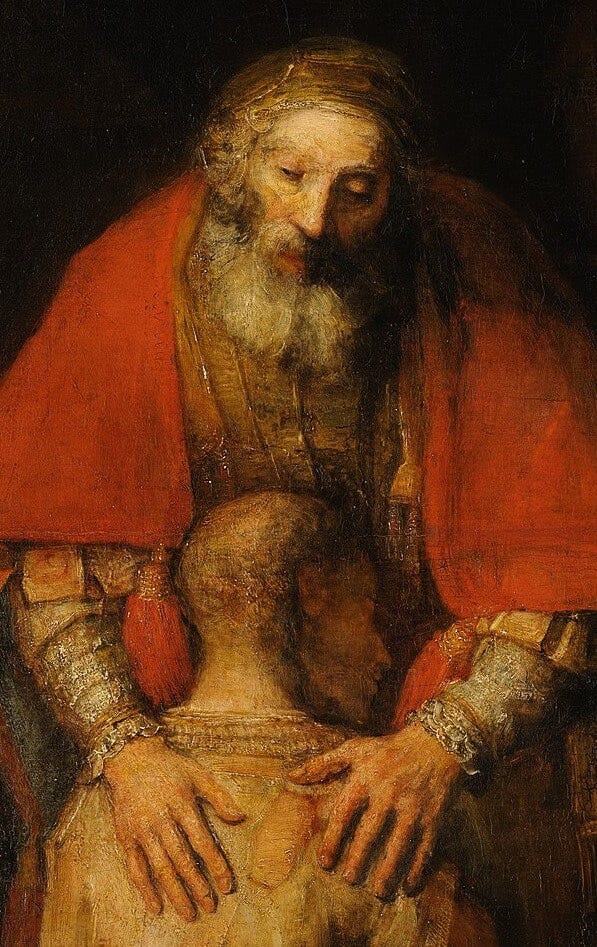
The grace of recognition is most richly epitomised in another story unique to Luke: the parable of the prodigal son. Here, in the King James translation, the moment when the prodigal son decides to return to his father is also a moment of self-recognition. Realising the complete degradation into which he had fallen, ‘he came to himself’. Earlier, the King James language wonderfully captures his decline into prodigality, as he travelled to ‘a far country’, a country, in other words, where he would not be recognised, ‘and there wasted his substance in riotous living’. The son’s ‘substance’ here is of course his material possessions, but also something more vital to himself: his essence, both physical and spiritual. There is something horribly seedy about his wasting it, as in Shakespeare’s ‘expense of spirit in a waste of shame’. The journey to a far country where he would be free to remake himself as he wished has simply allowed the son to deface that image God had made in him, and to make himself all but unrecognisable.
There is another fine detail when the son returns, and rehearses what he will say to his father. When he comes to say it, the first sentence is repeated word for word, but the father responds before the son finishes his apology, implying that the son is interrupted almost mid-sentence by his father’s immediate generosity. The son has been recognised: not as the ‘hired servant’ he wants to be, but as a son.
Luke’s gospel of human defacement and divine recognition ends with a flash of human recognition. After his execution, Jesus reappears to his disciples twice, and twice disappears as soon as they realise who he is. Reading the gospels, and perhaps especially reading Luke, is a process of almost coming to know something which remains just beyond the understanding, so this final chapter with its recognitions and disappearances makes a perfect coda to a narrative of half-understandings (though of course, with Acts to follow, the story has barely begun). The gospel’s meaning is often most elusive when it seems closest, just when we think we have refined its complexity into a political creed or a single formula for living well. It is just at this moment, when we glimpse something of the truth, that we find ourselves back with the disciples who recognised Jesus in the man who ate with them. ‘And their eyes were opened, and they knew him; and he vanished out of their sight.’