The Bostonians

The Bostonians nearly killed Henry James’s career. He published the novel in 1886, the same year as The Princess Casamassima. Both books deal with unusually political subject-matter for the usually recondite James, and both were commercial and critical failures. Considering the Boston of The Bostonians was just recovering from the civil war, in a country where slavery was a recent memory, its politics feel surprisingly familiar. The Bostonians are a pair of idealistic young women, Olive Chancellor and Verena Tarrant. The two share a commitment to the liberation of women, albeit one which Olive has developed with more clarity. Olive and her allies speak a language of progress against oppression. Their chief opponent in politics is the southern conservative Basil Ransom, whose language is also oddly familiar. He espouses a theory of ‘the longhouse’ avant la letter (‘the masculine tone is passing out of the world… [it’s an age of] coddled sensibilities, which, if we don’t soon look out, will usher in the reign of mediocrity’). It is for this reason that The Bostonians inspired an article by Sameer Rahim on what James can tell us about the culture wars.
More than politics per se, however, The Bostonians is about the conflict between politics and personal life. Ransom might be a political rival, but this role is soon eclipsed by another, as Verena realises that Ransom’s keenness to take her for long walks debating politics is not wholly disinterested. With this realisation, the book’s central problem comes into focus. Does Verena accept Ransom’s proposal, giving up her promising career as a public speaker advocating for women’s liberation for a private life spent admiring him; or, does she remain committed to the cause, to Olive, and to the goal of convincing the Boston public that women deserve a proper education and the vote?
The choice might sound simple, but Ransom’s charms outmatch not only the schoolmarmish Olive, but also the whole Bostonian public, to which the title also of course refers. When this public is represented most clearly, it is in a somewhat sinister mode, in the novel’s final scene, where a huge audience gathers to hear Verena speak in the Boston Music Hall. ‘The city of Boston is under this roof’, the organiser declares; the Bostonians as private group, of Olive and Verena and various hangers-on, are brought ‘face to face’ with the anonymous mass of Bostonians to whom the novel has not seen fit to introduce us individually. Depending on your perspective, the latter are either ‘the most magnificent audience ever brought together’, or a ‘roaring crowd’ gathered ‘to gape and grin and babble’.
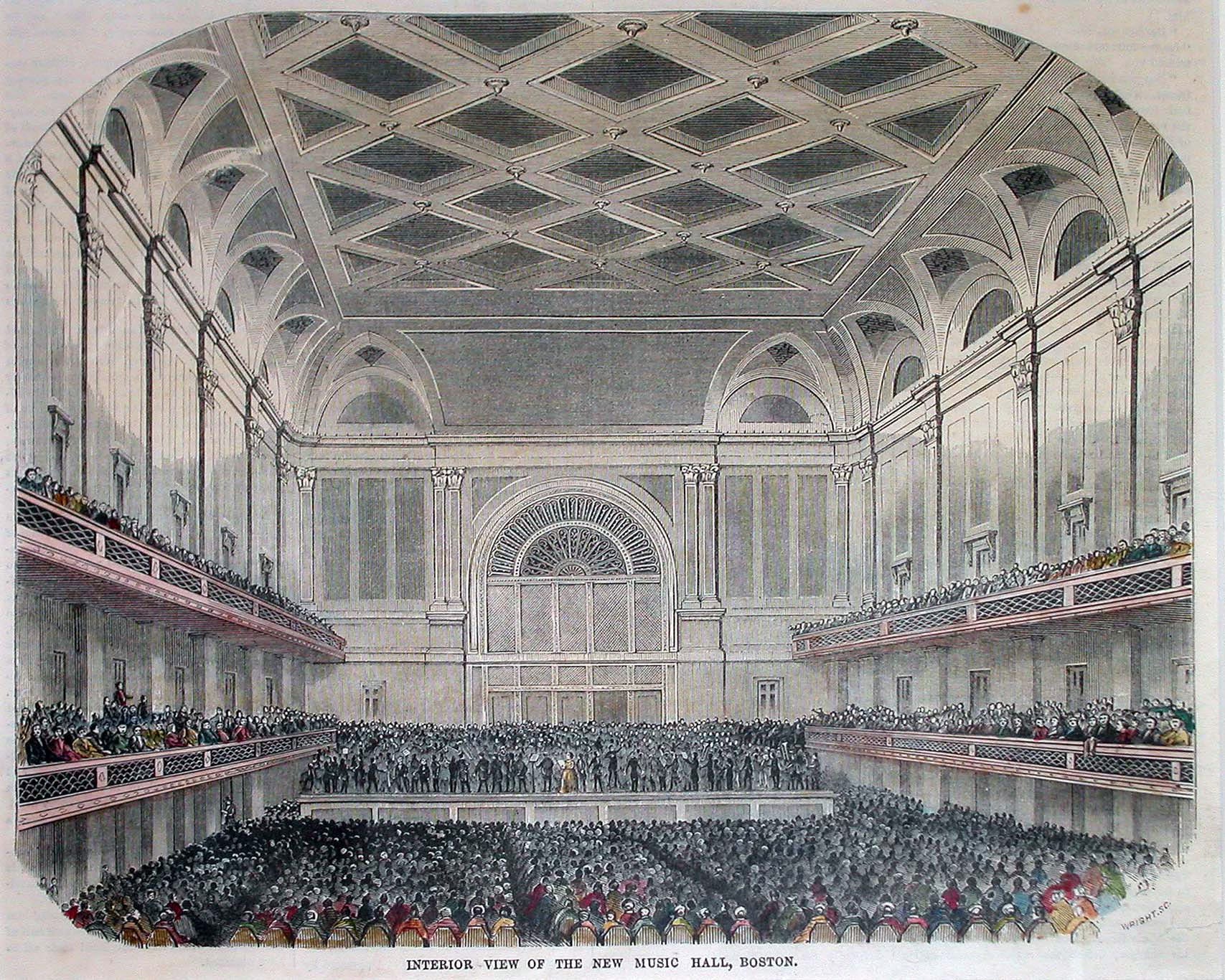
Given the hall’s height, with its ‘lofty vaults and rows of overhanging balconies’, and huge organ which ‘lifted to the dome its shining pipes and sculptured pinnacles’, the word ‘babble’ seems especially significant, bringing to mind the one time in the Bible all the inhabitants of the earth gathered together sharing one language, and built ‘a tower, whose top may reach unto heaven’.
The novel as a form is perhaps always a little biased in favour of private life, against the crowd. The benefit which Verena’s public speaking would bring to an anonymous mass of people is nothing compared to what she brings to the people whom the novel has made known to us. Those who prioritise the anonymous crowd, however deserving, over named characters, tend not to be sympathetic. The most obvious example is Mrs Jellyby in Bleak House, who sends off letters to further a philanthropic mission in Africa, to the neglect of her own children.
In the Greek tragedy Antigone, the conflict between Creon and Antigone over whether she is right to disobey civil laws and bury her brother feels more evenly-matched. However sympathetic Antigone might be, in going against the polis she in a sense goes against the members of the polis who have assembled in the theatre to watch her. A novel has no such scruples. No matter how many other people have read a particular book, we experience it through the characters, not as a crowd. Bostonians be damned; of course Verena should prioritise her own happiness, and her lover’s.
The question of what would make her, who depends so much on pleasing others, happy, is unanswered and unanswerable. Neither of Verena’s options straightforwardly represents either public service or private happiness. Nor does either represent liberty, as she is essentially choosing between serving Olive or serving Basil Ransom. Nonetheless, her choice strikes me as characteristic not only of James’s social conditions, but also of our own.
For me, the main thing that James’s novel tells us about our current political predicament is that political persuasions and personal interests are always messily entangled. Political sanity does not so much consist, as I thought as an undergraduate, in signing up to an equitable system designed on purely rational principles, but more in understanding how one’s own needs, preferences and history fit in with society as a whole. It doesn’t have to be about eliminating one’s own selfishness, but understanding how that selfishness can be made to fit alongside others’ with the least friction.
Ransom is accused in that last scene of being selfish for prioritising his own and (arguably) Verena’s happiness over the Bostonian crowd, the extremity of private interest over the opposite extremity of public interests. The accusation might seem fair or completely unreasonable, depending on how the reader has felt about him over the preceding pages, and perhaps also depending on the reader’s instinctive political sympathies. A brilliantly-poised final sentence doesn’t fall either way.
These remarks about The Bostonians seem to me very misleading. You would never know from them how definitely and unambiguously James vindicates Ransom and his belief that Verena is to be fulfilled by marrying him not committing herself, alongside his cousin Olive, to the cause of 'women’s liberation': “She had evidently given up everything now -- every pretence of a different conviction and of loyalty to her cause; all this had fallen from her as soon as she felt him near …”
Saying that Olive and Verena “share” a feminist “commitment”, differing only in that Olive’s has been “developed with more clarity”, sets aside as if it didn’t exist Ransom’s (and James’s) conviction that Verena, in being tempted to give herself up to that (in English) very suspect thing a “cause”, is being false to deeper aspects of her own nature. Your own phrases (which surely ought to be used ironically) -- “the goal of convincing the Boston public that …” (be it what it may) and “a promising career as a public speaker advocating for …” (be that what it may too) -- themselves declare the hollowness of what Ransom, in the last scene, finds he is “ still … able to rescue her” from. That word ‘rescue’ may be Ransom’s but it comes authorised, as it were, by James.
And how could Ransom be sensibly said, selfishly, to ‘prioritise’ his and Verena’s happiness over the ‘public interest’ of the Bostonian crowd, when he recognises no such interest, when he thinks it the mere gape, grin and babble of a crowd that roars, a rabble that raves? What sense does it make to talk of prioritising, when what seems at stake is, on the one hand, one’s own happiness and that of the woman one loves and, on the other, the “howl and thump” of “senseless brutes”. It’s another word that, here, is fit only for irony.
And who accuses Ransom of such ‘prioritising’? Not James. Only characters such as Verena’s father, who promotes and hopes to profit from the rabble and whose judgements no one could possibly take seriously. Perhaps that final sentence might justifiably be called “brilliantly-poised” but hardly because it is poised equally between “the private” and “the public” interest, the former of which the novel, from start to finish, treats as real, the latter not. All that that sentence implies is that any marriage is likely to have tears in it and especially one between -- as we have just seen -- a man as (can we still say?) as masculine as Ransom and a woman (can we say?) as feminine as Verena? And as for that suggestion that what we are to understand by a marriage between the two is, for the woman, “a private life spent admiring” the man … it’s a remark that, it seems to me, could only be made by someone expecting it never to be read.