Reading John

The final gospel poses problems for this series. So far, I have focused on the differences between the synoptic gospels, to try and draw out the differing intentions of each evangelist. John is so different that it is hard to know where to begin. I’m not the only one who finds John difficult. Among biblical scholars, there seems to be less consensus about the historical circumstances surrounding John’s gospel than any other. Much about his text is oddly in-between. His style ‘is neither bad Greek nor (according to classical standards) good Greek’.1 He wrote, depending on whom you believe, either for Jews or for gentile Greeks. He may have known the previous gospels intimately, or not at all.
These stark differences bring into focus questions which have lain dormant behind my previous three essays on the evangelists: I have talked about how they differ, but not why. The Church could have synthesised all the gospels into one complete, authoritative account, but did not, instead leaving the four gospels to stand together, with all their mutual tensions. Reading them all together, their unity is undeniable, but the differences in emphasis are nonetheless stark. Two main reasons occur to me for the differences. One is that it underlines how Christianity makes real historical claims. Rather than making the story of Jesus’s life into a mere myth, the various gospel accounts encourage the individual believer to see through the contingencies of record towards a real, human figure, alive in the past. Second, plurality itself is valorised: memories and testimonies about Jesus spoke differently to each evangelist, and they will speak differently to each of us.
The gospels’ unity is achieved through the balances I’ve described in previous posts, and will also describe in John: though the gospels have different emphases, they also counter-balance within themselves the distortions which each emphasis might produce. John’s is the most strikingly different, and this difference can pose difficulties.
Difficulties invite simplistic explanations. The first time I remember hearing John characterised was at school. A friend remarked to me that John’s is the ‘most Catholic’ of the gospels (from him this was high praise). Though of course identifying any singular gospel as more ‘catholic’ than the others does violence to that word’s meaning, it is nonetheless easy to see what my friend meant. John’s gospel is systematic in its theology and unrelenting in its focus on the sacramental encounter between God and Man in Jesus. Unlike in Mark, Matthew and Luke, in John, Jesus does not break bread and say ‘This is my body’ at the last supper. But really this is because John’s gospel is so deeply eucharistic throughout, with Jesus saying ‘I am the bread of life’ near its beginning, and going on to say that his followers must eat his flesh and drink his blood to gain eternal life.
Also significant for a reading of John as the ‘most Catholic’ gospel is Jesus’s assured divinity. Unlike the other gospels, Jesus openly proclaims his status as Son of God almost from the very beginning. This emerges most clearly in a comparison of John’s feeding of the five thousand with the other gospels’. Here, Jesus is more assured than in the synoptic gospels, more clearly in control: there is no explicit statement that he is moved to act by the crowd’s neediness. In the synoptics a disciple asks Jesus where they can find bread in such a remote place. In John, it is Jesus himself who asks Philip this same question, but John specifies that Jesus is ‘making trial of him, for he knew what he was going to do’. John draws out most clearly the divinity in Jesus, and any questions which imply human doubts are done for the benefit of those around him. Similarly, after the raising of Lazarus, Jesus speaks to God in a way which flags his unity with the Father as openly as possible: ‘Father, I thank you for hearing me, and I know that you always hear me; but because of the crowd which surrounds me, I said it so that they should believe that you sent me.’
Passages like this are a far cry from the veiled hints of the synoptics. In the first three gospels, Jesus speaks in pithy, dense sayings and vivid parables, hinting at his divinity but seldom if ever openly stating it. In John, Jesus speaks in elaborate, often quite abstract discourses, some stretching over multiple chapters, making his divine status inescapable.2 By my count, John’s gospel contains only one parable, and even this is quite different from the synoptic parables, containing no characters or plot, just a comparison between Christ and the gate to a sheepfold.
Whereas the synoptics are mostly dramatic episode punctuated by brief teachings from Jesus, John’s gospel is more overtly theological, and more overtly structured. It contains seven ‘signs’, miracles which reveal something about Jesus’s nature, and seven ‘I am’ discourses. This might sound schematic or contrived, but what is remarkable is how naturally each ‘I am’ statement and each sign arises from its context. For instance, the first of the ‘I am’ discourses, ‘I am the bread of life’, comes after the feeding of the five thousand, as Jesus underlines to his disciples how the earthly food he has given the crowd is nothing compared to the spiritual food he will also give.
This gets at the central paradox of John’s gospel: he depicts Jesus at his most divine, but also his most human, in the sense of being most entangled in human relationship. Jesus’s first sign, turning water into wine in the wedding at Cana, is elicited by his mother. The Virgin Mary is not named in John’s gospel, making her both a more intimately personal presence (Jesus’s mother, defined simply by her relation to him) and a more abstracted one: Mother, or even Woman, in general. It is this unnamed ‘Jesus’s mother’ who asks her son to provide wine for a wedding-feast which has run dry, which Jesus initially resists. The King James renders his response: ‘Woman, what have I to do with thee? mine hour is not yet come.’ Apparently, this makes Jesus unnecessarily rude, as the vocative of ‘woman’ used here could be a term of respect in Greek, and rather than recusing himself from responsibility in a fit of adolescent pique, Jesus is saying that his mother need not bother herself about the wedding’s poor logistics. Lattimore writes instead: ‘What is that to you and me, madam? My time is not yet come.’ Though Jesus is at least not insolent this way, ‘madam’ feels even less apposite than ‘woman’. Lattimore notes that ‘mother’ might also fit, but ‘woman’ has a wonderful strangeness which is surely worth preserving. By calling her ‘woman’, Jesus preserves her anonymity, and thus preserves also the combination of intimacy and universality which is so particular to John. Calling her ‘woman’, Jesus speaks as God to humankind, recognising us a species apart. But he speaks also as a respectful and loving son, and one so loving that he begins his ministry not whenever he sees fit, but when his mother asks.
Even the very beginning of Jesus’s ministry feels less intentional than the other gospels, more haphazard. John the Baptist points Jesus out to two of his own disciples, who then follow Jesus to his own home. Nathanael is convinced that Jesus is the Messiah because Jesus already seems to recognise him, having seen him under a fig tree. Jesus’s answer has a similar wry, slightly detached amusement at humanity as his response to his mother at Cana: ‘Because I told you I saw you under the fig tree, you believe? You will see greater things than that.’ The ironic tone here seems to me, in translation at least, to be John’s most distinctive stylistic feature.
Irony is not a trivial amusement in John, but a way of conveying the bizarre conjunction of divine and human intent. Much later in the narrative, Caiaphas, the high priest, explains to a gathering of high priests and Pharisees that they must kill Jesus: ‘it is expedient for us, that one man should die for the people’. He means simply that if Jesus attracts too much attention, the Romans might see his leadership as a threat and assume even greater control over Palestine themselves. John adds of Caiaphas that ‘this spake he not of himself’: his words have a far greater meaning than he realises, as Jesus really will die for the sake of the people. And yet this death is enacted simply for the sake of expediency, because it is politically convenient.
I had always thought it odd that Francis Bacon should call Pilate ‘jesting’ at the opening of the first chapter of his Essays: ‘What is truth, said jesting Pilate, and did not stay to hear the answer’. John’s gospel is uniquely preoccupied by abstract questions, which are most strikingly addressed during the passion narrative, when Pilate engages with quite a sophisticated discussion of political authority with a braying crowd,3 and asks Jesus this question in response to his claim that ‘everyone who is on the side of truth listens to my voice’. Considering the prevalence of Johannine irony, Bacon’s ‘jesting’ seems quite appropriate: Pilate diverts the conversation onto an abstract plane to avoid the searching moral implications of his prisoner’s claim, but his words have an ironic doubleness, hovering between cold-hearted dismissal and genuine curiosity. He might just be ‘jesting’, but really the game is being played on him, as his question reveals how little he knows about what ‘truth’ is, something he could discover if only he ‘stayed to hear the answer’.
Once Jesus has died and been brought to life, there is another ironic, accidental recognition, as Mary Magdalen mistakes the risen Jesus for a gardener. Here I could not put it better than Lancelot Andrewes, the great Jacobean divine responsible for much of the King James Bible translation. Andrewes preached to King James himself on Easter Day 1620 that Mary ‘did not mistake in taking him for a gardener: though she might seem to err, in some sense, yet in some other she was in the right’. Christ was indeed a gardener, in that he ‘makes all our gardens green’ in springtime. He ‘gardens our souls too’ and, in his own resurrection, ‘made such a herb grow out of the ground this day, as the like was never seen before’. As Andrewes puts it slightly earlier in the same sermon: ‘there was error in her love, but there was love in her error too.’ John’s ironies redeem human weaknesses, making good on Caiaphas’s cynicism, and finding truth in the mistaken apprehensions of his followers.
Nowhere is sign more closely linked to both doctrine and human need than in the raising of Lazarus.4 Here we see a love not ‘in error’, but brought to perfection precisely through human weakness. When Jesus hears from afar that his friend Lazarus has died, he is ‘glad’ for the disciples’ sake that he has this opportunity to reveal his power of life and death. Even for Christ, this sanguinity is possible only from a distance. Once Jesus arrives at the scene of the death and confronts Lazarus’s sisters Martha and Mary, he is anything but ‘glad’. When Martha complains that if he had been here, Lazarus would not have died, Jesus initially responds with a distant statement of doctrine, albeit one which has echoed powerfully through centuries of liturgy and even a Stone Roses song: ‘I am the resurrection and the life’. But when Mary repeats the same complaint, ‘he raged at his own spirit, and harrowed himself’. Lattimore finds this line ‘Very difficult’ to translate, but concludes ultimately that Jesus’s rage is not self-reproach but self-incitement: ‘not in anger but something close to it, furious urgency, Jesus is nerving himself to an extraordinary act.’ King James’s translators imply if anything the opposite, a spiritual desolation which verges on impotence: ‘he groaned in the spirit and was troubled’. Jesus feels completely the human cost of his final ‘sign’.
The totality of this feeling is epitomised in his response to being told where Lazarus is buried: ‘Jesus wept’, famously the shortest verse in the Bible (though the division into verses was the work of much later editors and is irrelevant to a consideration of John’s original composition). Preaching on this verse in 1623, John Donne noted that it redeems human frailty we all share, as the fragile stuff we are all made of is inhabited by Christ also: ‘the Holy Ghost loves to work in wax, and not in marble’. Of all the gospels, it is clearest in John that we are redeemed most often not through anonymous acts of charity, and far less from a love of humanity in the abstract. Instead, we are redeemed through the contingencies of relationship, those relationships imposed on us by circumstance, through which we play our part in the human drama.
Thus for Donne, Christ’s tears are ‘tears of imitation’, his weeping an act we must emulate in feeling deeply the losses this drama will inevitably inflict on us: ‘And when God shall come to that last act in the glorifying of Man, when he promises to wipe all tears from his eyes, what shall God have to do with that eye that never wept?’ Donne’s question captures something essential to the Christian life. A life lived without tears, without loss, without need of God, leaves God with nothing to do, nothing to work on. Rather than being admirably self-sufficient, this also raises the question of ‘what shall God have to do’ in another sense, the same sense in which Jesus asked his mother ‘What is that to you and me’ at Cana. God really will have nothing to do with those who make themselves self-sufficient. To refuse to be worked on by God is to refuse membership of his kingdom, that kingdom of ‘friends’ Christ institutes in John’s account of the last supper.
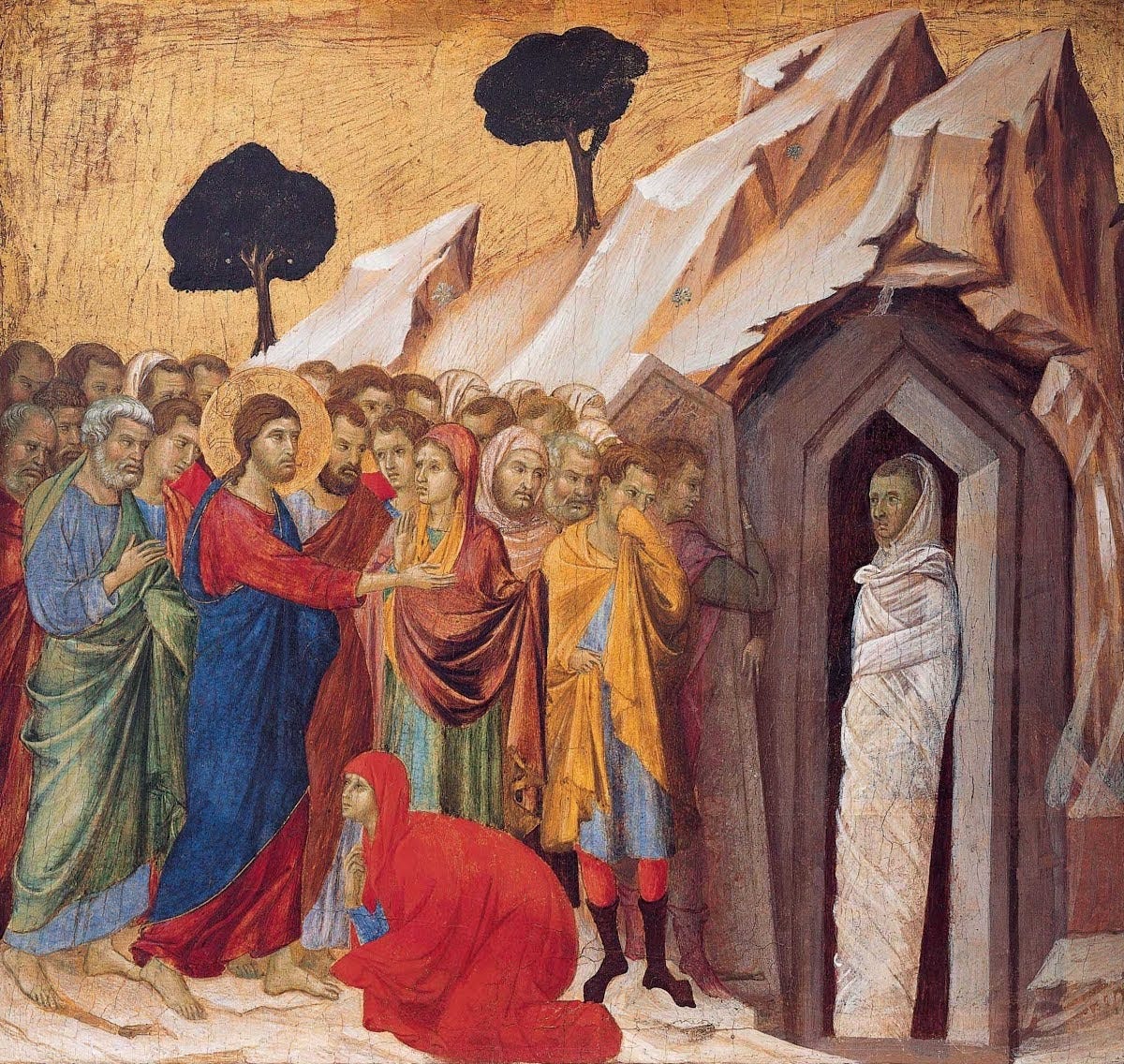
There is a mystery unique to John’s gospel, to which the raising of Lazarus may be the key. Whereas in the other gospels, Peter appears to be Jesus’s favoured disciple, in John there is another, unnamed ‘disciple whom Jesus loved’. Leaning against Jesus’s breast, it is to this beloved disciple that Jesus reveals the identity of his betrayer. This beloved disciple is mentioned only after the raising of Lazarus, and is revealed at the narrative’s conclusion to have been John’s principle source: ‘This is the disciple which testifieth of these things, and wrote these things: and we know that his testimony is true’. The fact that Jesus is so deeply moved by Lazarus’s death, and that it is Lazarus who hosts a feast in Jesus’s honour after being raised from the dead, has led some to speculate that Lazarus was the beloved disciple. If it was Lazarus who ‘wrote these things’ on which John based his gospel, then the final gospel is based on an earlier ‘gospel of Lazarus’, available only to John, which would explain its significant differences from the synoptics.5
I won’t speculate any further on the gospel’s sources or authorship but, taking this idea that the ‘beloved disciple’ might be Lazarus, it is notable that he is described as the one whom Jesus loved only after being raised from the dead. There is perhaps a reiteration here of the lesson of Jesus’s weeping: that it is precisely in our need for God that we become loveable. From a distance, Jesus is ‘glad’ at Lazarus’s death, but up close he weeps. Then seeing Lazarus reborn (as depicted memorably by Duccio), swaddled in a shroud like baby-clothes, Jesus’ disciple becomes ‘beloved’ in a way possible to those whose needs are infinite.
One can think of analogues. C.S. Lewis supposedly fell in love with his future wife only when he saw her sick in hospital. Hopkins wrote in ‘Felix Randall’: ‘This seeing the sick endears them to us, us too it endears.’ Professor Eamon Duffy quoted this line in a wonderful eulogy for his friend Fr Mark Langham, formerly Catholic Chaplain to Cambridge University. Caring for the sick can make them very dear indeed.
John’s gospel is said to have the ‘highest Christology’, the most acute sense of Jesus as God-in-Man. But it is also the gospel which has Jesus most moved by human neediness, washing the disciples feet at the last supper, as we remember especially today, Maundy Thursday. Peter tries to refuse the foot-washing, but Jesus insists, giving the disciples a model of exaltation through lowliness. The Meister des Hausbuches depicts it beautifully: Peter placing a friendly hand on Jesus’s arm, the kind of touch which accompanies the words ‘this round’s on me’; Jesus looking at him as a friend, but also looking higher, his finger pointing upwards in a gesture that partakes in benediction and amicable reproach, reminding Peter that these proceedings have a greater purpose. One could even call this greater purpose an ironic significance, as Jesus’s action is a model for future emulation, even if it makes little sense at the time.
There is error in Peter’s love, by trying to refuse the washing, but love in his error also, implying as it does a recognition of Christ’s divinity. Perhaps this erroneous love is the best fallen Man can hope to achieve, saying with Peter ‘Thou shalt never wash my feet’, and then allowing one’s feet to be washed. There are some blessings which should be received only with reluctance. The Meister’s Judas seems impatient for Jesus to get to him, his feet wide open for the washing, his open hand inviting a blessing he does not deserve for many reasons, one of these reasons being the fact of his inviting it. Faced with Christ’s humility, the only love possible to us is love ‘in error’.

In John, Christ is at his highest and his lowest. John gives the most complete account of Jesus’s identity, but also the one which draws the most attention to its incompletion. Jesus says towards the end of the lengthy last supper discourse: ‘I have many things to say unto you, but ye cannot bear them now.’ And John notes at the very end of the gospel as a whole that Jesus did ‘many other things’ which he does not record, things which would fill more books than are in the world.
John’s gospel is the most abstract, but also contains many of the most vivid sensory details, which are often inextricable from their wider theological import. Frank Kermode notices this especially during the passion, when the most arresting details are also those which seem to fulfil Old Testament prophesies, so that John’s passion ‘strikingly combines what may be called reality-effects with an ability to comply with other literary texts’ (Kermode, p. 105).6 This connection between vivid detail and theological import is evident before the passion also. Martha warns Jesus of her brother’s body: ‘by this time he stinketh: for he hath been dead four days.’ In the next chapter, the risen Lazarus hosts a feast for Jesus, and his other sister, Mary, anoints Jesus’s feet with valuable oil, rubbing it in with her hair, ‘and the house was filled with the odour’. The two smells are both responses to the physicality of death: the stench of decomposition, and the expensive oil intended to hide it, as this oil is used to embalm the dead. The connection between the smells underlines an important plot-point. Jesus raising Lazarus means Jesus taking Lazarus’s place, as it is this act which leads the authorities to conclude that Jesus is a mortal threat who must die ‘for the people’. And the connection in the plot is also a theological connection. Jesus takes Lazarus’s place in the tomb, just as his death will obviate the deaths of all humanity. Whereas Lazarus’s death, before Jesus’s arrival, implies the horrid smell of decomposition, Jesus’s death smells sweetly of spikenard. Realism and symbolism are inextricable. Death has lost its sting and, with it, its stench.
Though of course nothing in the gospel is ever as neat as this. If the ointment fills the room with a funereal smell, the room of feasting is also a burial chamber, one which also contains the disciples, even Lazarus himself. But the narrative importance of this shift from stench to ointment still stands: Jesus has rid the world of the smell of decay (though Duccio’s onlooker in a yellow cloak does not seem to realise this), but because of this must face the smell of his own impending death.
There is pattern here, but not system. Something rich and deeply suggestive, but wrought out of human contingency as well as divine forethought. This can make John’s language difficult. In John, Jesus speaks at length and with great theological richness, largely without parables, but this is not to say that he speaks plainly. Jesus quotes the verse from Isaiah about people seeing and not understanding which in the synoptics occurs at the parable of the sower, making this verse (I believe?) the only passage from the Hebrew Bible quoted in every gospel, outside the Passion.7 The pattern here is of partial understanding, revealed to a few.
Patterns have human costs. In narrative terms, John’s gospel ends with Thomas’s doubts, then the commissioning of Peter. Peter is ‘grieved’ when Jesus asks him a third times whether he loves him or not. As a reader, it is hardly surprising that Jesus should ask this question three times, the scriptures being full of triads. But Peter does not know that he is in the scriptures, and he is ‘grieved’ because his friend and master seems unsure of his loyalty. He is grieved also because the triadic questioning repeats the crowing of the cock three times at his betrayal of Jesus in the high priest’s courtyard. The message of John is that he is right to be grieved. Jesus must ask three times in part because what he asks is so momentous: loyalty, even unto death. Jesus predicts the death Peter will die for answering his questions faithfully:
when you were younger, you girded yourself up and walked about wherever you wished; but when you are old, you will stretch out your hands, and another will gird you and carry you where you do not wish to go.
When I heard these words read at Fr Mark Langham’s funeral, I did not realise they came from almost the very end of the gospel. Hearing this same reading which had been read at his ordination thirty years earlier, the comparison of young and old, walking about where one wishes and being carried where one does not wish to go, seemed all too clear.
Reading them again now, at the end of the fourth gospel, how they address Peter is less certain. Peter is between youth and age. He once walked about as he wished, and he will be carried where he does not wish to go, by people who hate him and what he represents, but unwittingly do the will of a God in whom they do not believe. But for now, at the gospel’s close, Peter is neither young nor old. His will is neither wholly his own nor wholly God’s. He is suspended, like us readers, between divine will and human contingency, and that is where John leaves us.
C.K. Barrett, The Gospel According to St John: An Introduction with Commentary and Notes on the Greek Text (SPCK, 1982), p. 5.
There is, however, a hint of a messianic secret. After performing miracles in Jerusalem at the beginning of his ministry, many people believed. ‘But Jesus himself did not entrust himself to them’, for the mysterious reason that ‘he had no need for anyone to tell him about man, for he himself knew what was in man’.
That this discussion is, though abstract, imbued with menace comes through most piercingly in Bach’s John Passion, where the crowd is voiced with a hatred so lusty it is almost gleeful. Even in the opening chorale, before the crowd has really turned on Christ, the choir wield the word ‘Herr’ like a weapon, making this term of respect a tuneful shriek.
Though one could also compare another incident unique to John: Jesus’s intervention to spare the woman caught in adultery from being stoned. This story is absent from the earliest manuscripts, so though canonical it seems likely that it was not written by John himself, but based on a parallel oral tradition. Augustine suggests that the story was suppressed by husbands who feared it would make their wives too confident in God’s forgiveness of infidelity.
See Mark W.G. Stibbe, John as Storyteller: Narrative Criticism and the Fourth Gospel (Cambridge University Press, 1992), pp. 77–82.
Frank Kermode, The Genesis of Secrecy: On the Interpretation of Narrative (Harvard University Press, 1979), p. 105.
Please do correct me on this if I am wrong.
I really enjoy your writing.
Coincidentally, the sermon at my parish church this morning was on John and some of these passages.
The minister asked why we thought he specified that the disciples caught 153 fish. Any thoughts? (I've asked Chat GPT!)