Reading Mark
Privacy and wholeness in the first Gospel

I am planning to write a reflection on each gospel for the remaining Sundays in Lent (sorry that this one is late). The versions I am using are the KJV and Richmond Lattimore translations, with quotations from the latter unless otherwise stated. My aim is to read the gospels as whole narratives in themselves, rather than, as so often happens, taking short quotations or episodes out of context, though I’m sure the difficulties this approach poses will be more than evident in what follows.
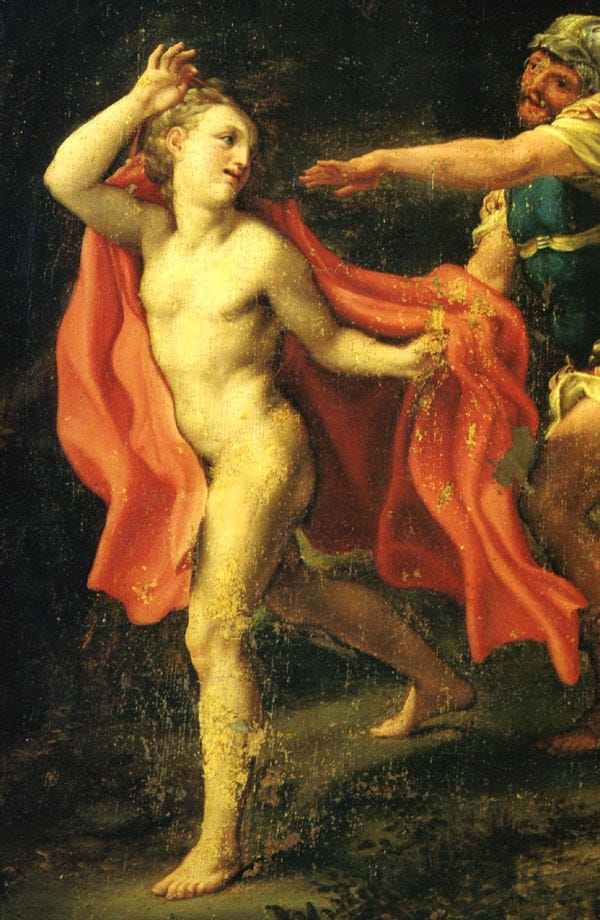
Mark’s is the first gospel. This is true both in terms of its likely date of composition and more personally, as it was the first gospel that I ever read, when I studied it at GCSE. I remember more from these lessons than from any others at that time. Classes covered topics like why Mark’s Jesus is so secretive about his identity (‘the Messianic Secret’) and whether the mysterious young man who appears only in Mark’s gospel, running away naked from Gethsemane after a soldier grabs his linen cloak, might be an authorial self-portrait.
These discussions (which were really lectures, and all the better for it) were interspersed with theatrical tirades from our teacher at boys who were paying insufficient attention. He delivered these outbursts at short range, leaning both arms on the boy’s desk and bellowing his face purple. I was, you will be shocked to hear, never reprimanded, though I did struggle to arrive on time. I’m not sure I read the gospel the whole way through, as not all of it was examined. This seems bizarre to me now given how short it is: you can read the whole thing comfortably in an hour, which surely even fifteen-year-olds are capable of doing, especially pre-TikTok.
My second encounter with the gospel also took place in an institutional setting, as I wrote an essay on Mark for an undergraduate paper on ‘Tragedy’. This was crammed with undigested Greek copied and pasted from an online interlinear edition, crammed also with references to Church Fathers from an anthology of patristic commentaries, and written in my typical attempt at a Grand Style of criticism which tutors most often, to my dismay, labelled ‘journalistic’.
I was especially taken at the time by Frank Kermode’s book The Genesis of Secrecy, which reads Mark’s Gospel through the lens that all interpretation is some kind of exclusion, and that we must always be disappointed by the plurality of meanings in the texts we go to hoping for singularity of sense, for transparency and truth. Kermode’s book, which contains many sensitive readings of the Gospel’s symbolism and use of ‘intercalation’ (more on this later), concludes on a suitably pessimistic note:
World and book, it may be, are hopelessly plural, endlessly disappointing; we stand alone before them, aware of their arbitrariness and impenetrability, knowing that they may be narratives only because of our impudent intervention, and susceptible of interpretation only by our hermetic tricks. Hot for secrets, our only conversation may be with guardians who know less and see less than we can; and our sole hope and pleasure is in the perception of a momentary radiance, before the door of disappointment is finally shut on us.
Poetically resonant though this passage might be, reading Mark as a text which shuts the door on its reader is an interpretation so perverse that only a literary critic could have thought of it. The gospel begins by describing itself as ‘the gospel of Jesus Christ’, making its meaning inescapable.
Reading Mark now, what strikes me most is how crowded it is. This is true of the text itself, which is so dense with incident it is hard to keep up, but also of the physical spaces in which Jesus’s ministry plays out. He is constantly avoiding crowds. In The Four Loves, C.S. Lewis notes the oddity that should be the Jesus not only of the cross, but also ‘of the workshop, the roads, the crowds, the clamorous demands and surly oppositions, the lack of all peace and privacy, the interruptions’. Though utterly unlike the peace and glory of God in himself, this is ‘the Divine life operating under human conditions’. Still, Jesus is keen to gain some privacy, and is often taking himself or a small group of followers away to a mountaintop, a wilderness, or on a boat across a lake. That he still seeks this privacy is evidence not only of a divine prudence (not wishing to attract too much attention too early, which might have hastened his demise) but also of a human nature which felt the crush of the crowd and wanted some peace.
Both of Mark’s most distinctive features are related to this constant overcrowding. The aforementioned ‘Messianic Secret’, Jesus’s reluctance to tell anyone about his true status as God and saviour, seems to be motivated at least in part by a desire not to draw too many people to follow him. And Mark’s own strategy of ‘intercalation’, inserting one narrative into the middle of another to make a kind of textual sandwich, also contributes to the gospel’s ‘crowded’ nature in two senses. Both are evident when Jesus is approached by a man called Jairus, who asks Jesus to heal his daughter. While Jesus is on his way to Jairus’s house, a woman from the crowd touches his cloak and is healed of a haemorrhage. Feeling that power has gone out of him, Jesus asks the crowd who touched him, which confuses the disciples because there are so many people there: dozens have been touching him. But the woman knows what he means, and identifies herself. Jesus then goes on into Jairus’s house.
The intercalation of the two events, the healing of the daughter and of the woman with the haemorrhage, makes the text itself crowded with incident, but also more literally crowded, conveying that Jesus can’t even walk a few steps without someone coming up, grabbing his cloak and insisting on being healed. At times Jesus seems to exercise careful control on his ministry, but many of the most enduring incidents of the gospel seem to be contingent, being forced on Jesus by his surroundings. His passion and death are the culmination of this balance between contingency and choice, as he submits in Gethsemane to a series of events which he cannot control.
Reading Mark as a whole, it is difficult to see how much of the narrative itself is contingent, a collation of oral testimonies, and how much has been shaped by its author (Mark, and through him the Holy Spirit) into coherence, by choice. This is particularly true of John the Baptist, who appears before Jesus at the very beginning of the narrative, and is said to have been betrayed. Only later does Mark recount how Herod had John beheaded at the behest of his step-daughter, his body taken to the tomb by the disciples.
Mark moves from John’s story back to the primary narrative by saying that the apostles, having been sent out in pairs to heal the sick, ‘reported all they had done’ to Jesus. Does this include the death and burial of John the Baptist, or had this all happened much earlier? If Jesus only learned of this now, mid-way through his ministry, it gives an added significance to his desire to be alone:
He said to them: Come with me, you only, to a private place and rest a while. For there were many coming and going and they had no opportunity even to eat. And they went away on their ship, privately, to a deserted place.
Jesus made Herod think of a reincarnated John. There is a perverse half-truth to Herod’s misapprehension, as of course John’s fate foreshadows Jesus’s own. Read this way, Jesus’s desire for rest is not only exhaustion at the number of people coming and going, but also a desire to come to terms with what these crowds will later do to him. This makes what immediately follows all the more astonishing as an act of love beyond self-will, as Jesus gives up his privacy to teach the crowds who have followed him. This culminates in the feeding of the five thousand (itself one of the only events before the entry into Jerusalem, and the only miracle which appears in each of the four gospels), a foretaste of the bread of life Christ will give his followers in the eucharist.
This context even makes some sense of what has always for me been the most troubling part of Mark’s gospel. Having delivered the parable of the sower, Jesus tells his followers the real meaning in private to his disciples, explaining that ‘to those who are outside, all comes through parables, so that they may have sight but not see, and hear but not understand, lest they be converted and forgiven’. It makes sense, given the constant threat of being found out too soon, that Jesus should keep the full radicalism of his message from the crowds for a while longer. But the obscurity is not meant to be permanent. Jesus says to his disciples moments later:
Surely the lamp is not brought in so as to be set under a basket or under the bed rather than to be set on a stand; for there is nothing hidden except to be shown, nor anything concealed except to be brought to light.
Jesus’ choices of what to do in the open and what in private are important throughout the gospel. When he heals a man with a withered hand on the sabbath, he deliberately takes him out of the synagogue, partially perhaps to lessen the severity of the offence in the eyes of officialdom, but also to make it clear that Jesus’s resistance to the status quo is not clandestine, but something he is willing to do and see done.
Mark’s is the shortest gospel. Much is missing which is typically considered central to Jesus’s life and teaching: there is no word about Jesus’s childhood, no good Samaritan, no Lord’s prayer. Things are emphasised which are no longer much talked about in Western Christianity, at least as I have experienced it: Judea is full of demons of various kinds, one of which is so powerful that the disciples cannot cast it out, only Jesus himself. Demons cause sickness and self-harm, and though the language of demons is not popular today it seems quite appropriate to many contemporary trends, not least the destruction of the environment. The desire for profit at the expense of all else is surely its own kind of possession—and how apt the word is.
The gospel bursts into life with small details, though these are often where it is more obscure. The apostles James and John are the ‘sons of thunder’, but we do not know why. ‘What a Majestick change’, said John Donne of their new names, which surely inspired his gloriously tempestuous image of the relationship of preaching to sacrament:
Preaching is the thunder, that clears the air, disperses all clouds of ignorance; and then the Sacrament is the lightning, the glorious light, and presence of Christ Jesus himself.1
These flashes of presence occur throughout the gospel. Moments such as the half-healed blind man seeing ‘people, like seeing trees walking about’, are so strange they feel completely real. Faced with these flashes of presence and certainty, but also with the continuing obscurity and fragmentariness of Mark’s account, I can only say, with the father of the boy possessed by the most powerful of demons: ‘I believe. Help my unbelief.’
Donne preached this at the Spital Cross on Easter Monday 1622. He also called preachers ‘sons of thunder’ in a sermon on Mark 4:24, preached at Whitehall on 1st April 1627. The comment about James and John’s ‘Majestick change’ is from the Essayes in Divinity.
I only skimmed this when it first came out, but reading it again now... absolutely beautiful. I am making time this afternoon to read Mark thanks to this